CoTV™
Technology Overview
What is new, and how does it work |

|
CoTV™ can change the media world by enabling
coordinated linkage between TV and the Web...
-
From any TV program or
advertisement
-
Without need for special
action by TV programmers
-
Without need for special
action by TV distributors
-
To any Web site
-
With basic services
provided from any standard Web URL
-
With value-added
context/sync services easily added (possibly for premium fees)
-
For any TV + Web
consumer
-
With basic linkage for any
standard TV + Web/PC pair
-
With value-added automatic
context linkage provided in various ways
Participation by TV programmers and distributors is desirable to provide
added value and increased services, but is not essential to enable a rich suite of CoTV
services. |
|
CoTV™ works with
current PCs (and other Web devices) – and will gain in power as wireless laptops,
tablets, PDAs, and cellphones (as well as entertainment gateways) become ubiquitous in the
networked home.
CoTV services
– based on the viewer's
TV-context –
can span a wide range of levels:
- from: simple, unobtrusive use in ad servers to
synchronize a cross-media counterpart to any TV ad, into any Web page
- to: full-function portals or other Web
services with deep and varied TV-related content and commerce resources, and with optional
inclusion of advanced smart-client features
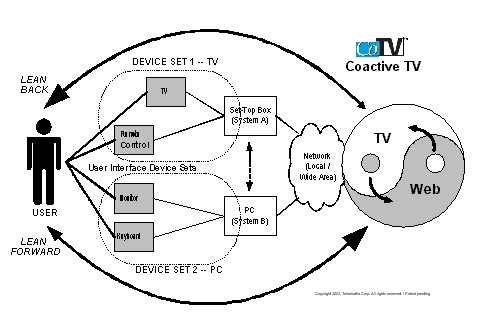
A key requirement for CoTV is obtaining the TV context information
that is needed to individually coordinate the coactive Web experience for each viewer (via
a CoTV portal). Fully automated coordination of context is a basically a matter of
- sensing the current channel or program on the TV*
- passing that simple information to the PC (such as by wire, wireless,
or infrared)
- linking to coordinated Web services with the assistance of a CoTV
portal or Web service (based on program ID or schedule look-up).
...The reverse process of using Web links (or other controls) on the
PC to control the TV is also supported, for full two-way coordination.
Full automation can be provided in a variety of
ways -- the connection can be made in the home, or through an external service.
- Cable or satellite (or TelcoTV or other IPTV) operators
can add this capability through their installed set-top boxes and head-end networks, with
no need for a home network. Cable operators (MSOs) are particularly well positioned
to provide CoTV coordination and portal services to create an important new revenue
stream. See The CoTV Portal for MSOs (...or Satellite).
- Media Center PCs are particularly attractive as a
ready and open market -- one that does not require cooperation by third parties, and that
is growing to substantial numbers. CoTV context tracking software can easily be
added to a Media Center PC (or to any similar entertainment gateway, DVD player, and
digital TV set that permits open extensions to its software). This installed base is
already in the millions, and can be expected to reach the tens of millions within a few
years. See CoTV™ and the Home Network / Media Center
/ Gateway.
- Consumer electronics vendors can provide similar
features directly into their products (DVRs,
DVD players, and digital TV sets, gateways, etc.), for use with home networks). See CoTV™ and the Home Network / Media Center / Gateway.
- Media adapters can also be provided directly to
consumers, at low cost, to interchange remote control commands in the home, even for
closed set-top boxes.
Semi-automated coordination can be used in the near term
with any legacy TV and PC, to quickly embrace a critical mass of all interested
viewers. This can deliver much of the value of coactivity with no need for TV-PC
communication at all. Semi-automated use with an attractive suite of services could
establish an early critical mass – and demonstrate the attraction of more fully
automated methods to both users and the industry.
*Other media: CoTV is equally applicable to
any other video, or to audio or other media. |
|
Some context association details: A key step in
CoTV context association for current systems is the mapping of current channel data to
identify a current content item (program or ad). This can be done without need for
any kind of coding or triggers to be made available by programmers or distributors. For
programs, this can be a simple program guide lookup. For ads, this can be a similar
lookup, based on realtime ad tracking data obtainable from any of a number of existing
broadcast monitoring services. (Of course if interactive triggers are embedded, they can
be used by CoTV services. Similarly, with digital TV systems, identifications may be made
directly from any embedded program ID or ad-ID.)
|
|
|
|
Coactive TV
User-centered Convergence 2.0
new media technology from 
CoTV Today and Tomorrow
CoTV was
ahead of its time in 2002 ...and still is
Now TV "screen-shifting" and "companion" apps are now
changing how people watch TV.
-
iPhone and iPad
awakened the giants -- as an irresistible platform for coactive
TV apps.
-
AirPlay and
Chromecast have made screen-shifting easy and popular
-
Social TV apps (about
what you are watching now) are drawing users.
-
Distributors
are promoting 2nd screen apps and increasing openness.
-
Independents
are using ACR (Automatic Content Recognition) to do it for
themselves.
-
Twitter Ad Targeting and
Comcast See It are bringing rich new functions to a mass
market
The time is ripe for ubiquitous
"always-on" TV sync
-- a single app and context portal for any companion content for any
show (and any ad).
TV is ready to
be reborn for the 21st Century!
...and
still more advanced CoTV features are yet to come.
...Recent
blog postings on CoTV developments |
Blog:
Reisman on User-Centered
Media
...Recent
postings on CoTV
Usage scenarios for advanced features:
CoTV in the news:
Coactivity concept -- initial white papers
(from 9/02):
|
|
