Coactive TV:
User-centric integration of TV and Web use
...Multitasking and simultaneous media
use with a power assist |

|
|
With CoTV™,
the viewer's PC automatically coordinates Web links with any TV viewing, and vice versa.
This creates a new compound medium that is natural, simple, and powerful. |
|
- CoTV™ exploits the fact that a growing mass of consumers are already
“coactive” – watching TV while on the Internet – and that is
increasing as broadband and wireless laptops gain ubiquity) [see FAQ].
- Much of that simultaneous
(multitasking) media usage is presently uncoordinated, as viewers do unrelated
tasks concurrently.
- One reason it is uncoordinated is
that TV and the Web now do almost nothing to facilitate coordination of TV viewing with
Web browsing.
- Some users do seek out TV-related content on their own – whether
provided by TV programmers as "Enhanced TV," or just related pages on third
party sites, tangential surfing, or advertiser Web sites.
- Imagine how much more effective this simultaneous media consumption
would be – for users, programmers, advertisers, and other content providers – if
there were a way to harness TV-context to organize Web content and links.
- CoTV™ Web portals act as a special Web search engine that is
continuously and automatically driven by TV-viewing context.
CoTV™
coordinates TVs and PCs to work together, to support a multitasking viewer in
power-assisted coactivity.
- This transcends any need for costly
"convergence" into one universal box that cannot do all things well, while
exploiting the natural inter-working of devices in the networked home.
- CoTV™ is neither the-Web-on-TV,
nor TV-on-the-Web – it is an new kind of combined medium.
- CoTV™ facilitates interaction with Web content that is related to what is on TV.
- Examples include getting more information about what is on
the TV, whether sports, movies, news, or the like, and participation such as games,
contests, etc.
- Similar (and most likely to pay the bills), is getting more
information about what is being advertised, along with the ability to buy it.
- This can include Web-based enhancements provided by the TV
program (or ad) producers, but it can optionally include any relevant resources or
services on the Web.
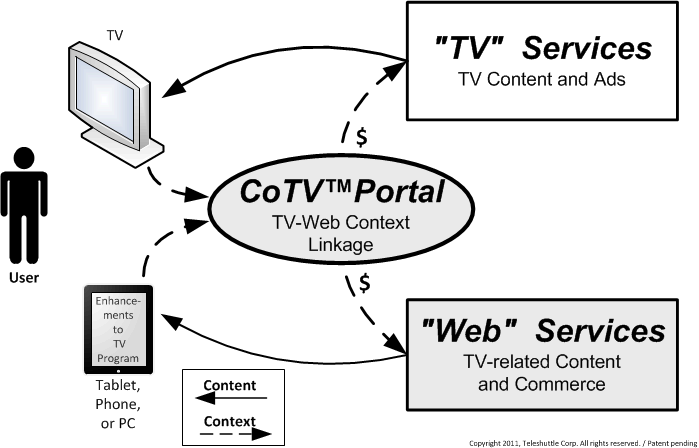
CoTV™ will enable an entire
new media business ecology, based on new forms of content and new ways to link TV
advertising to direct response on the Web.
Just as
search engines transformed the Web and supercharged its value, CoTV can do the same to
simultaneous Web and TV use.
…for users:
- Support viewer multitasking behavior by automatically presenting Web
content that is related to the current TV-viewing-context. See Why I want my CoTV™.
- Enable full “coactivity” -- direct coordination between a
user’s channel selections and other commands at their TV with related enhancement
content at the PC – and similar coordination back to the TV -- unlike current
“two-screen” "Enhanced TV" services.
- Achieve user-centric flexibility and ease of use. CoTV can
allow users to bookmark links and/or pause TV, to shift back and forth between
simultaneous multitasking and intensive use of either TV or the Web -- and advanced
version can enable control over which resources appear on which screen.
…for programmers and advertisers/direct marketers:
- Enable effective use of deep enhancement content and powerful direct
response marketing that seamlessly integrates TV and Web channels into a truly convergent
medium -- with one-to-one capability for on-demand and addressable services, and use in
synchronous or deferred modes. See Integrating TV and Web
Advertising
- Bridge all standards for content and services into a national
assemblage of interworking technologies, and use PC Web access as a universal default
format for enhancement content, without limiting exploitation of one-screen-capable
households.
…for cable operators (or IPTV or TelcoTV, etc.):
- Create new fee-based services and CoTV portals that can add value to
any enhancement content source by linking TV and PC access via the cable head-end -- and
provide a business model for win-win collaboration between cable operators and
content/enhancement providers and advertisers. These can include subscription fees
to users and advertiser fees. See The CoTV Portal for MSOs
(...or Satellite).
…for satellite operators:
- Use wireless or wired STB connections to a user PC with Internet
connectivity to deliver full two-way interactivity and enhancement content in one-screen,
two-screen, or any-screen mode. See The CoTV Portal for
MSOs (...or Satellite).
…for other video/audio distributors (Internet
streaming, IPTV, TelcoTV, DVD, CD, radio, etc.):
…for consumer electronics and PC
hardware/software/middleware providers:
- Enable any combination of TV and/or PC (or PDA) devices to be used to
deliver a rich new coactive TV experience.
- Exploit PVRs, Media Center PCs, and media adapters to facilitate
direct bi-directional linkage of TV and PC devices. See CoTV™
and the Home Network / Media Center / Gateway.
- Enable similar coactivity for other video and/or audio devices and
services.
- Establish a well-defined, standard demarcation for interchange of
sessions and state between devices.
CoTV™ goes far
beyond old ideas of "interactive TV" (ITV), while avoiding the pitfalls that
have plagued the field.
- CoTV™ builds on the wide use and
acceptance, of the Web -- and its open standards and infrastructure
-- to apply
the wealth of content and services already available on the Web, and to facilitate
economical addition of CoTV-specific content and services. (Such content and
services can be restricted to "walled gardens" if desired.)
- CoTV™ makes 2-screen ITV user-friendly and
powerful. Unlike current 2-screen "sync-TV" ITV that provides PC/Web
enhancements, CoTV™ coordination can be always on, and automatically
responsive to individual channel surfing, video-on-demand, and advanced features for
personalized viewing. The viewer need not find a specific program's Web site, and
does not lose sync whenever the channel or program changes. CoTV™ builds on the
limited success of 2-screen ITV -- and on the proliferation of wireless laptops and tablet
PCs (and PDAs) -- to make 2nd-screen use ubiquitous, automatic, natural, and powerful.
TV-related content is provided to the user – the user need not figure out how to find
it.
- Advanced versions of CoTV™
can include 1-screen interaction modes as well. Unlike current 1-screen ITV,
CoTV™ does not require costly advanced set-top boxes, and
is not limited to the simple interactions that are viable with TV screens and remote
controls -- but where such platforms are in place, CoTV™ can
enable a flexible, user-centric blend of 1-screen and 2-screen interaction modes.
|
|
|
|
Coactive TV
User-centered Convergence 2.0
new media technology from 
CoTV Today and Tomorrow
CoTV was
ahead of its time in 2002 ...and still is
Now TV "screen-shifting" and "companion" apps are now
changing how people watch TV.
-
iPhone and iPad
awakened the giants -- as an irresistible platform for coactive
TV apps.
-
AirPlay and
Chromecast have made screen-shifting easy and popular
-
Social TV apps (about
what you are watching now) are drawing users.
-
Distributors
are promoting 2nd screen apps and increasing openness.
-
Independents
are using ACR (Automatic Content Recognition) to do it for
themselves.
-
Twitter Ad Targeting and
Comcast See It are bringing rich new functions to a mass
market
The time is ripe for ubiquitous
"always-on" TV sync
-- a single app and context portal for any companion content for any
show (and any ad).
TV is ready to
be reborn for the 21st Century!
...and
still more advanced CoTV features are yet to come.
...Recent
blog postings on CoTV developments |
Blog:
Reisman on User-Centered
Media
...Recent
postings on CoTV
Usage scenarios for advanced features:
CoTV in the news:
Coactivity concept -- initial white papers
(from 9/02):
|
|
|
Teleshuttle offers license to CoTV patents.
CoTV technology can be offered by service
providers in TV, Internet, e-commerce, and allied fields. Teleshuttle seeks to cooperate
with all industry participants to develop and apply these methods to facilitate
simultaneous media multitasking, to assist in the development of services, reference
designs, and standards, and to license this technology broadly for widespread use. |
Richard Reisman -- Bio
Consulting/About
Contact Information
Richard R. Reisman, President, Teleshuttle Corporation
20 East 9th Street, New York, NY 10003
(212)-673-0225
e-mail: info@teleshuttle.com |
Site Search
|
|
Teleshuttle
home - CoTV home - Concept - Tech - Cable/Sat - MediaCenter - CoTV Ads - Users - Why CoTV/FAQ - About Teleshuttle
| Coactive media: Relating to media
multitasking. The simultaneous or alternating use of two or more media, such as TV
and Internet (Web, etc.), especially where the using of the media is synchronized or
coordinated –
typically (but not necessarily) on multiple devices or screens. Coactive TV: Relating
to multitasking use of both television and the Internet (Web, etc.). The simultaneous or alternating use of TV and the
Internet, especially where the using of both media is coordinated or synchronized, and
especially where the TV and the Internet browser are automatically coordinated with one
another – typically
(but not necessarily) on multiple devices or screens. |
Copyright 2011, Teleshuttle Corp. All
rights reserved. / Patents pending
|
