FairPay ̶
Customer Dialogs about Value
The greatest danger in times
of turbulence is not the turbulence,
it is to act with yesterday’s logic.
--Peter Drucker
Set prices are "so
last century" ̶ they do not make sense for digital.
FairPay is a flexible new architecture
for buyer-seller relationships...restoring
and expanding the traditional wisdom that prices should be personalized.
-
Enables better pricing,
centered on the customer
-
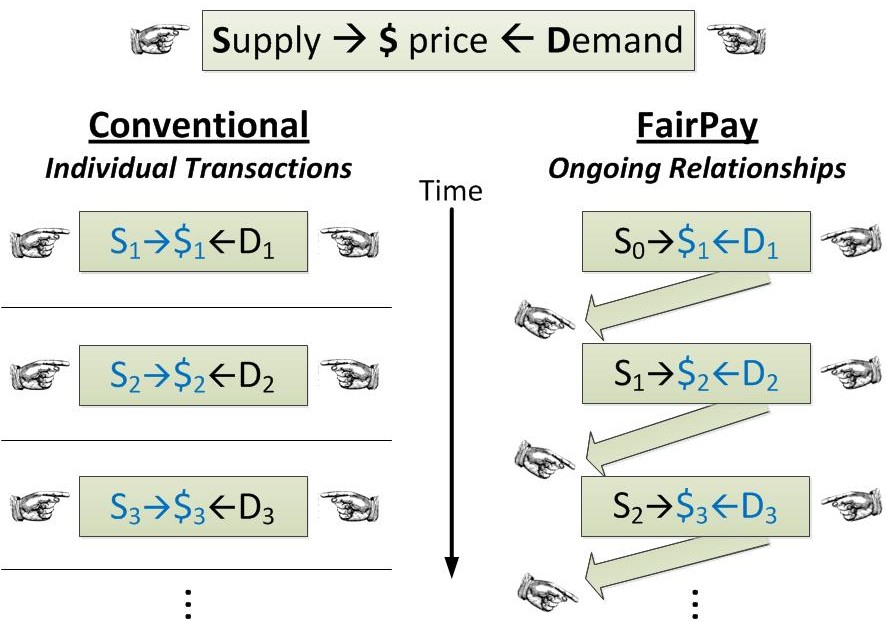
Shifts focus from transactions to relationships
-
Builds deep buyer-seller relationships
centered on customer empowerment, experience, and dialog
-
Operates as an adaptive value discovery engine that sets prices based on
individual value perceptions
FairPay offers sustainable
advantages:
-
Higher customer satisfaction
-
Increased market efficiency
-
Far deeper market penetration, for more profit
|
Teleshuttle is working on a pro-bono basis
with industry and academic partners
on research, trials, and applications of FairPay. |
FairPay exploits Internet feedback and reputation tracking in a subscription,
or other ongoing sales relationship.
It is especially suited to digital content, products, and services.
FairPay is a participative
pricing process
that combines
• the user empowerment of pay-what-you-want pricing, with
• feedback, accountability, and seller control of future offers
to make it
fair to both buyers and
sellers in a continuing relationship.
|
Whatever price the seller set is wrong!
...wrong for some of the people all of the
time.
...wrong for all of the people some of the time.
FairPay changes that with a new twist of the invisible hand
...one based on total realized value to each buyer. |
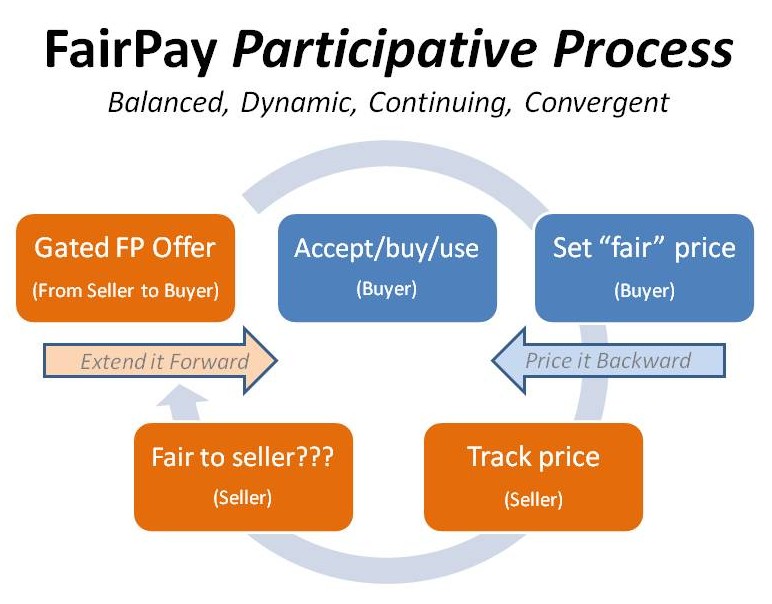
FairPay works over a relationship, through a very simple
balancing dynamic:
1. Selectively
empower the buyer to unilaterally set
whatever
value-based price the buyer considers fair
-- after the sale, when the real value is experienced and known.
2. Track that buyer value-based price and determine whether
the seller agrees that is fair, and use that information
to empower the seller to decide whether to make further offers of that kind to that buyer in the
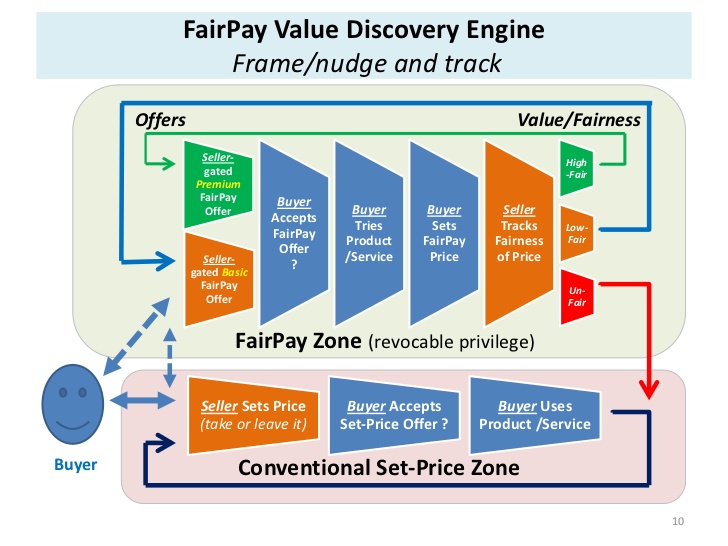
future. (Unfair buyers are downgraded to lesser offers or
fixed-price.)
3. Continue this balancing in future transactions, to build a relationship
based on fair value exchange, that adapts and evolves over time.
This
gives buyers a strong incentive to price fairly -- and enables
sellers to limit their future exposure to those who do not.
...more on How FairPay works |
|
Customers
-- Pay only what seems fair to you (based on your "Value2Me"):
-
Pay what you want
for products or services -- after you try them
-
Make every purchase
on a trial basis--so you can always be sure to get your
personal fair value
for your money
-
Agree to set your
price fairly--in your judgment--and explain why you think
it is fair
-
Do that as long
as you can convince the seller that you are being fair
|
|
Businesses
-- Get the most revenue from the
most customers by continuously learning what each one values:
-
Engage in real
dialog with each of your customers and listen to the personalized
"Value2Me" they perceive to get
from your products or services
-
Make a trial offer
to every potential customer who sees potential value.
-
Let your customers
self-select into segments (based on usage, value
perception, willingness and ability to pay, ...)
-
Limit your
risk from those trial offers by tracking the results
(fairness) for
each buyer, and limiting future offers if you judge that buyer
to not pay fairly
-
Continue to make
every offer a trial...
...as long as each buyer continues paying fairly--in your
judgment
Delight your
customers: give them what they really want, at a price they
really think fair. Shift the conversation from price to
value.
Empower them to engage with you |
Pay What You Want has been
shown to be profitable for special offers.
...With FairPay (short for Fair Pay What You Want),
every offer is a special offer.
|
The strategic value of
FairPay to business
FairPay is a pricing discovery and management process that provides
• More effective pricing -- based on "Value2Me" (as perceived by
each customer)
• Greater customer reach, delight, and loyalty
• The ultimate in market research:
transaction-level value
perception and behavior detail
...for every transaction by every buyer
• Fine-grained buyer self-segmentation
to create a new framework for win-win value exchange. FairPay lets you
outsource your pricing to your customers -- they know better than
you what perceived value you provide them.
Adding to the business
opportunity, FairPay tracking
processes build a Pricing Fairness Reputation Database on customers
(much like a credit rating database) that becomes a valuable asset.
When applied in a cross-vendor platform service, this database
offers an added first-mover advantage.
|
|
The invisible hand meets
the cloud
...A new economics for the Internet age
The Internet “cloud,” and the networked
economy it enables, has opened the door to a historic leap in human
culture, but that leap is hobbled by the need for a new
economics--one that can deal with the abundance of value that this
new economy creates.
-
The very structure of our
transactions, and the “invisible hand” that guides them, is
unsuited to an economy in which digital goods can be replicated
and delivered in unlimited quantity at negligible cost. With
unlimited supply, prices are driven to zero, and the invisible
hand of our established
pricing mechanisms no longer works.
-
We need to
turn the invisible hand to guide an efficient and fair
exchange of value between producers and consumers of digital
culture.
-
We
must exploit new information on actual value to each buyer, as it emerges out
of each transaction and use, in the context
of ongoing buyer-seller relationships.
|
|
Radical, but practical and prudent...
FairPay is radical in offering a degree of buyer participation in
price setting that may seem foolhardy, but is balanced by mechanisms
for sellers to manage risk and predictability.
FairPay
is also prudent in being:
-
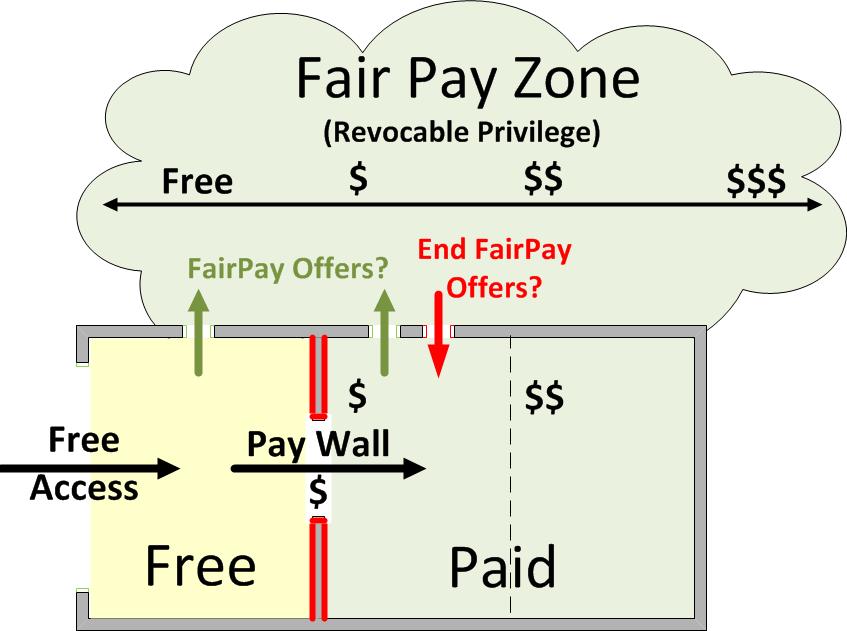
Usable in harmony with conventional
pricing schemes (pay walls, freemium, etc.), as a complement, not a
complete replacement.
-
Deployable in limited/niche segments
and phases, to gain value and experience, without any risk to
established revenue streams.
|
more on How FairPay works...
Seeing the full power of FairPay, and how
it works, takes a step outside conventional thinking.
...Please contact us
for free consultation
...on how it can work for your business:
fairpay@teleshuttle.com
Teleshuttle is working on a
pro-bono basis with industry and academic partners on
research, trials, and applications of FairPay. |
|
|
|
|
|
Seeing the full power of FairPay, and how
it works, takes a step outside conventional thinking.
...Please contact us
for free consultation
...on how it can work for your business:
fairpay@teleshuttle.com
Teleshuttle is working on a
pro-bono basis with industry and academic partners on
research, trials, and applications of FairPay. |
|
|
|